Monday, September 14, 2015

Winston the spendaholic: He teetered on the brink of bankruptcy and was saved by secret backhanders. Yet a new book on Churchill's finances reveals he spent £40,000 a year on casinos and £54,000 on booze

  • Churchill spent most of his life swimming in a mountain of personal debt
  • Gambled equivalent of £40,000 a year on holidays to the south of France
  • Had £54,000 bill from his wine merchant, including £16,000 for Champagne
  • Secret benefactor gave him £1million in 1940 as he became Prime Minister 
The confession was a startling one, in light of the great man he became. ‘The only thing that worries me in life is — money,’ wrote Winston Churchill, then aged 23, to his brother, Jack. ‘Extravagant tastes, an expensive style of living, small and diminished resources — these are fertile sources of trouble.’
Indeed they were. For the qualities that were to make Churchill a great war leader came very close to destroying him time and again during his career, as manic optimism and risk-taking plunged him repeatedly into colossal debt.
In the Thirties, when he was a married man with four dependent children and already borrowing more than £2.5 million in today’s money, he would gamble so heavily on his annual holiday in the South of France that he threw away the equivalent of on average £40,000 every year.
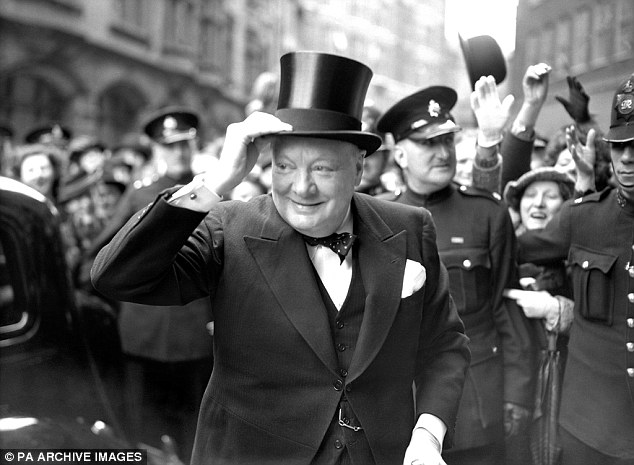
Qualities that were to make Churchill a great war leader came very close to destroying him time and again during his career, as manic optimism and risk-taking plunged him repeatedly into colossal debt. But he became one of Britain's greatst heroes and is here receiving the Honorary Freedom of the City of Westminster
In my own career, advising families on tax affairs and investments, I have never encountered addiction to risk on such a scale as his.
To a biographer, one of Churchill’s most convenient characteristics is that he left his own bank statements, bills, investment records and tax demands in his archive, despite the evidence of debt and profligate gambling they reveal.
In contrast to his well-documented periods of anxiety and depression, when the ‘black dog’ struck him, there were phases when he gambled or traded shares and currencies with such intensity that he appeared to be on a ‘high’ — devoid of inhibition, brimming with self-confidence and energy.
As a result, he left behind a trail of financial failures that required numerous bailouts by friends, family and admirers.
And it was only by a wildly improbable intervention, almost an act of God, that he wasn’t bankrupt in 1940 instead of Prime Minister: as war loomed, a secret benefactor wrote two cheques for well over £1 million to clear Churchill’s debts.
His inventive efforts at tax avoidance would spell scandal if attempted by any politician today.
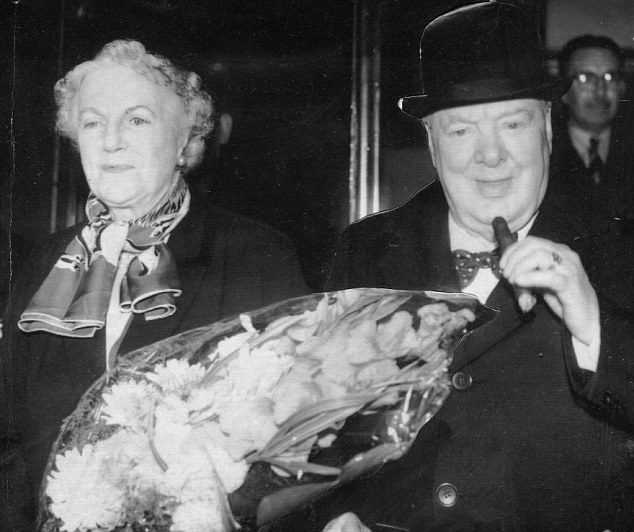
In the Thirties, when he was a married man with four dependent children and already borrowing more than £2.5 million in today’s money, he would gamble so heavily on his annual holiday in the South of France that he threw away the equivalent of on average £40,000 every year
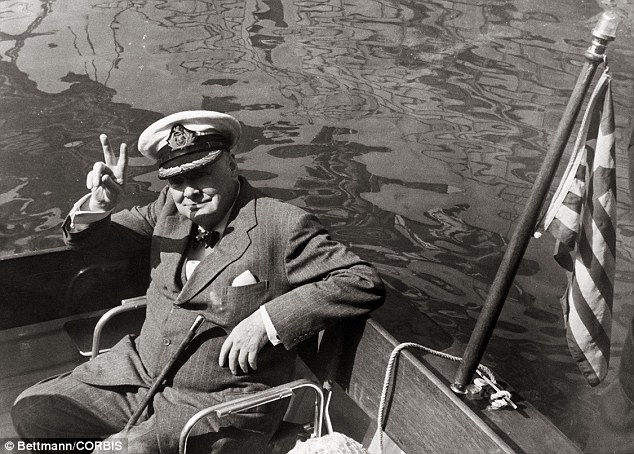
One of Churchill’s most convenient characteristics is that he left his own bank statements, bills, investment records and tax demands in his archive, despite the evidence of debt and profligate gambling they reveal. He's pictured here riding in a motor lauch in the harbor at Safi, Morocco
Though he wrestled to control his spending all his life, the defining disaster of Winston’s financial career was the Wall Street Crash of 1929.
Churchill always told his friends his losses in the Stock Market collapse amounted to $50,000 — or £500,000 today. But that is only part of the story.
These were Winston’s years in the wilderness when, having served for a term as Chancellor of the Exchequer, he was suddenly out of power.
This was not without its benefits, for at last he was able to devote time to writing books and churning out newspaper columns to keep the bank at bay.
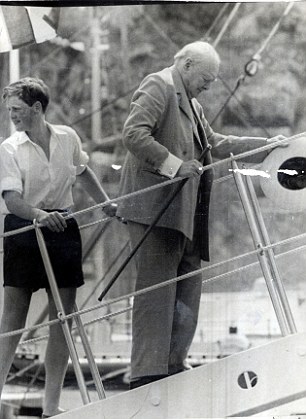
 As a result, he left behind a trail of financial failures that required numerous bailouts by friends, family and admirers
 As a result, he left behind a trail of financial failures that required numerous bailouts by friends, family and admirers
In return for his high fees as a journalist, Churchill’s friends among the press proprietors expected colourful copy that ran against the conventional political wisdom. He delivered it, but his trenchant commentaries made rehabilitation within the political establishment very difficult.
The problems began when he embarked on a North American tour to promote his book on World War I, The World Crisis, accompanied by his brother Jack and son Randolph.
He travelled through Canada by private railcar, sleeping in a double bed on board with a private bathroom. ‘There is a fine parlour with an observation room at the end,’ he wrote to his wife Clemmie, ‘and a large dining room which I use as the office. The car has splendid wireless installation, refrigerators, fans, etc.’
Surrounded by these modern marvels, Churchill began to trade again in shares and commodities. He was intoxicated by Canada’s money-making opportunities, especially in exploration for oil and gas.
Gripped by investment fever as he reached the prairies, he wired his publisher to demand an advance on his royalties, boasting of the profits he could grasp if he acted without delay.
To allay Clemmie’s concerns, he told her of the cash he was making by selling his book at public appearances — 600 copies in Montreal alone — and casually announced he had ‘found a little capital’ with which he ‘hoped to make some successful investments’.
He plunged tens of thousands of dollars into oilfields and rolling stock, assuring his bankers that, ‘I do not expect to hold these shares for more than a few weeks’.
In the States, he stayed with media tycoon William Randolph Hearst and bought stakes in electrical ventures and gas companies, before heading to California where he indulged in late-night parties with Hollywood’s movie elite and toured the studios.
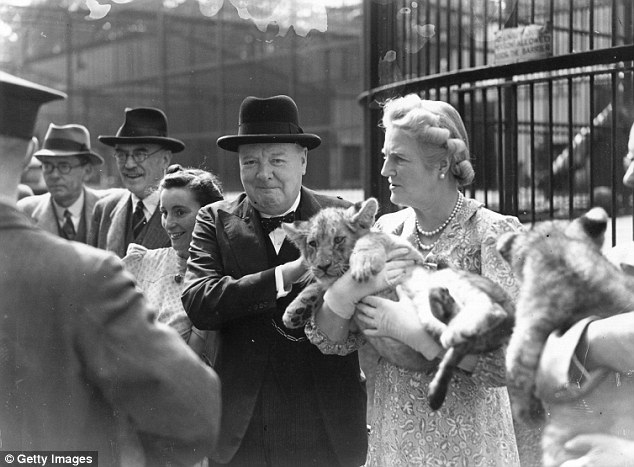
In contrast to his well-documented periods of anxiety and depression, when the ‘black dog’ struck him, there were phases when he gambled or traded shares and currencies with such intensity that he appeared to be on a ‘high’ — devoid of inhibition, brimming with self-confidence and energy
After lunch with Charlie Chaplin on the set of his latest film, City Lights, Churchill boarded Hearst’s yacht and wrote to Clemmie that he had banked £1,000 (£50,000 today) by cashing in some shares in a furniture business called Simmons.
‘You can’t go wrong on a Simmons mattress,’ he crowed — but failed to mention that he had $35,000 (a third of a million pounds today) still invested with them.
His buying had spiralled out of control. Everything he could raise was plunged into U.S. stocks, in businesses from foundries to department stores.
His brokers sounded warnings by telegraph: ‘Market heavy. Liquidating becoming more urgent. Will await your telephone. Your bank still losing gold & there are rumours of increase in bank rate.’
Churchill ignored them. In four days he bought and sold $420,000 in shares — or more than £4 million-worth now.
It was like a drug to him. ‘In every hotel,’ he told Clemmie, ‘there is a stock exchange. You go and sit and watch the figures being marked up on slates every few minutes.’
The crash was inevitable. At the opening bell in the New York Stock Exchange on Thursday, October 24, 1929, prices fell by an average of 11 per cent.
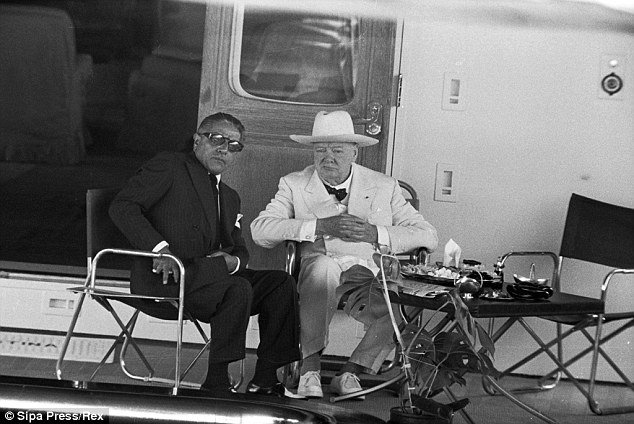
He wrestled to control his spending all his life, the defining disaster of Winston’s financial career was the Wall Street Crash of 1929. Churchill told his friends his losses in the Stock Market collapse amounted to $50,000 — or £500,000 today. But that is only part of the story. Pictured in 1958 with hipping magnate Aristotle Onassis
Churchill kept buying, confident of recouping his losses, right up to the moment he boarded an Atlantic liner to return home. By the time he reached Chartwell, his home in Kent, he was poorer by $75,000 (£750,000).
But instead of pulling in his horns, he tried to recoup — and within six months had lost another $35,000 (£350,000).
His efforts to cling to some kind of solvency became desperate. He borrowed money wherever he could — from his brother, his bank, his brokers, his publishers and newspaper editors. He arranged another speaking tour in America and took out insurance against its cancellation — then used the General Election of 1931 as an excuse for postponing and claiming his £5,000 (£250,000) indemnity.
He traded the insurers one of his oil paintings, in a deal he described as ‘highly confidential’.
Once the election was behind him, he set off to America — but, in his fraught state, stumbled into disaster.
Having arranged to meet a business associate in New York, he grabbed a taxi. But in his hurry, he forgot to take the man’s address. After a fruitless hour trying to find the building, he climbed out of the cab — and was hit by a car.
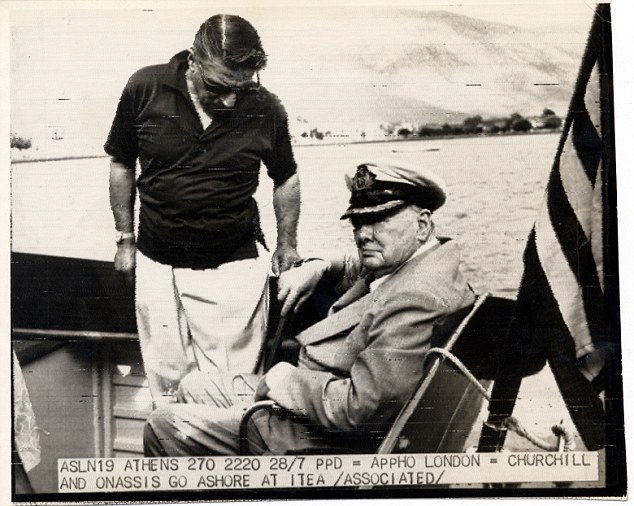
These were Winston’s years in the wilderness when, having served for a term as Chancellor of the Exchequer, he was suddenly out of power. This was not without its benefits, for at last he was able to devote time to writing books and churning out newspaper columns to keep the bank at bay
Even this was used as a means to scrape money together. He wrote a newspaper article about the accident, syndicated it worldwide for £600 (£30,000) and then claimed medical insurance on the spurious grounds he was ‘totally disabled’.
When the underwriters protested that he was still able to earn money from journalism, his broker retorted that he could not physically write — the article had been dictated to a secretary. Mere talking, he insisted, should not be classed as work. The insurers paid up.
Such sharp practice was not confined to his insurance claims. He told the Inland Revenue he had retired as an author, which entitled him to defer a large income tax bill.
To avoid paying tax on book royalties, he sold the rights and successfully argued that the money he received was not income but capital gains, which at the time was exempt from tax.
He borrowed money from his children’s trusts, and even cut down his drinking — not to curb his expenses, but to win a bet with the press baron Lord Rothermere, who wagered him £600 that Churchill would not drink any brandy or undiluted spirits for a whole year.
Churchill took the bet, reasoning to Clemmie that money won gambling was not subject to tax. But he turned down a bigger bet, £2,000 [£100,000], that he could not remain teetotal for 12 months.
‘I refused,’ he explained, ‘as I think life would not be worth living.’
In fact, his accumulated bills for alcohol came to £900 (£54,000). His gambling was even more costly — 66,000 francs (about £50,000) in a single holiday at a casino in Cannes in 1936, for example.
Clementine’s excesses were little better. That year, her bill at Harrods ran to more than 80 pages, with accounts, too, at Selfridge’s, Harvey Nichols, Peter Jones, Lillywhite’s and John Lewis.
Faced with a £900 [£54,000 today] demand from his wine merchants Randolph Payne & Sons in 1936, Churchill checked the bill and found the total came to even more — £920
Attempts at economising were feeble. Three servants were dismissed, with a saving of £240 [£14,400] and the same amount was cut from the laundry bill. The temperature of the swimming pool at Chartwell was also reduced in a bid to halve heating costs.
But by 1938, as the European situation with Hitler and Mussolini became critical, Churchill had run out of resources. Both Chartwell and his house in London were up for sale but had attracted no buyers.

CHURCHILL SANK 454 BOTTLES OF BUBBLY IN JUST TWO MONTHS


Faced with a £900 [£54,000 today] demand from his wine merchants Randolph Payne & Sons in 1936, Churchill checked the bill and found the total came to even more — £920 [£55,200], including £268 [£16,080] spent on champagne: ten magnums, 185 bottles and 251 pints of it.n At the outbreak of World War I, Churchill was smoking a dozen cigars a day, at about £13 a month [£1,300] — and he had not paid his suppliers, J Grunebaum & Sons, for five years.
Swimming in personal debt (about £1.5m today), Churchill announced some drastic household cutbacks in 1926, the year of the General Strike. The cost of food, servants and running a car were to be halved. ‘No champagne is to be bought,’ he warned his wife. ‘Only white or red wine will be offered at luncheon or dinner. No more port is to be opened without special instructions. Cigars must be reduced to four a day.’ The economy drive lasted less than three months.
On his way home from a Mediterranean cruise in 1927, Churchill — then Chancellor of the Exchequer — dropped in on the casino at Dieppe and, playing baccarat, lost £350 — the equivalent of £17,500 today.
Winston holidayed in the South of France 12 times during the Thirties and always gambled at the casinos. He came home a winner only once.
During World War II, his personal spending on wine, spirits and cigars was £1,650 a year [£66,000].
In a two-month spell in 1949, Churchill and his house guests at Chartwell drank 454 bottles of champagne, 311 bottles of wine, 69 bottles of port, 58 bottles of brandy, 58 bottles of sherry and 56 bottles of Black Label whisky.
His journalism could no longer even cover his back-taxes, and he had borrowed to the limit against his life insurance policies. Creditors were clamouring on all sides.
His overdraft had reached £35,000 (more than £2million) and his brokers were demanding an immediate payment of £12,000 (£720,000). His attempts to bargain were ignored.
‘For a while,’ he admitted, ‘the dark waters of despair overwhelmed me. I watched the daylight creep slowly in through the windows and saw before me in mental gaze the vision of Death.’
Salvation came from an unexpected quarter. Churchill turned to his friend Brendan Bracken, co-owner of The Economist, to find him a rescuer. Bracken, in turn, approached his business partner, Sir Henry Strakosch, who was a fervent admirer of Churchill. He was also immensely wealthy.
Two months earlier, at Bracken’s request, Churchill had visited Sir Henry at his house in Cannes. The 68-year-old, who had made his fortune at the helm of South Africa’s gold-mining Union Corporation, had been unwell and Bracken described him as a ‘lonely old bird’.
This slightest of introductions paid colossal dividends.
Sir Henry, a naturalised Briton born in Austria, regarded Churchill as the one politician in Europe with the vision, energy and courage to resist the Nazi threat.
He had no hesitation in paying off £12,000 (about £660,000 today) of his share-trading debts.
Neither man ever spoke publicly about the rescue. Churchill kept knowledge of it to a very tight circle that did not include his bank or his lawyers.
Sir Henry’s only reward was to be nominated for The Other Club, the dining society based at the Savoy in London that Churchill had founded with his fellow political maverick F. E. Smith.
At the outbreak of war in 1939, Churchill was appointed First Lord of the Admirality, with a salary of £5,000 (£250,000 today) — exactly what it was when he was last given this Cabinet post, 25 years earlier in 1912. The pay, though substantial, was nowhere near enough to cover his expenditure, let alone the interest on his outstanding loans, which totalled £27,000 [£1.6 million].
For years he had been working on his three-volume History Of The English-Speaking Peoples, but despite his prodigious output, he had been unable to deliver the finished manuscript and collect his fee. The book had got no further than the American Civil War, but undaunted, Churchill declared it to be finished.
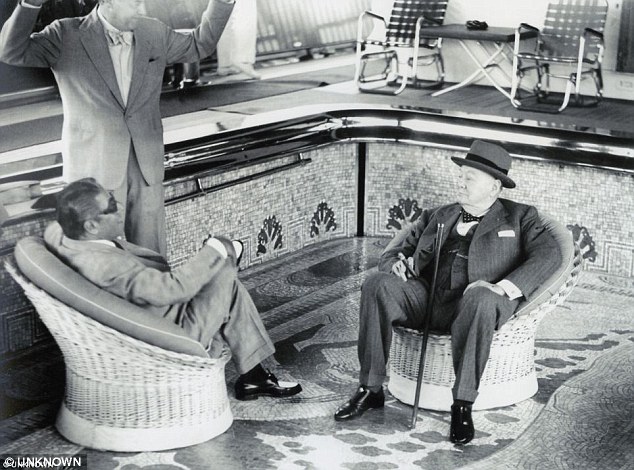
Swimming in personal debt (about £1.5m today), Churchill announced some drastic household cutbacks in 1926, the year of the General Strike. The cost of food, servants and running a car were to be halved. ‘No champagne is to be bought,’ he warned his wife. ‘Only white or red wine will be offered at luncheon or dinner
His publisher, Cassell’s, was dismayed at such an abrupt ending.
All protests were dismissed: Churchill was too busy to write any more. Reluctantly, Cassell’s paid up, which enabled him to pay £2,000 (£100,000 today) of overdue taxes and settle wine merchants’ bills that topped £3,000 (£150,000).
On May 10, 1940, as Hitler’s armies surged through Holland and Belgium, Prime Minister Neville Chamberlain resigned, and by evening King George VI had asked Churchill to form a government. Today, the choice of man seems inevitable, but at the time there was consternation.
‘Seldom can a Prime Minister have taken office with the Establishment so dubious of the choice and so prepared to find its doubts justified,’ wrote one of Downing Street’s private secretaries, Jock Colville.
Churchill’s salary as PM might have doubled to £10,000 (£500,000), but with the highest rate of income tax standing at 97.5 per cent, virtually all of it went to the Inland Revenue.
Just two weeks after the Dunkirk evacuation, in June 1940, the Prime Minister was facing an ultimatum from Lloyd’s Bank for interest on his £5,602 overdraft (£280,100).
Once again, Sir Henry came to the rescue with a cheque for £5,000 (£250,000). The receipts show a flurry of payments to shirt-makers, watch-repairers and, naturally, wine merchants.
Despite rationing, food and drink flowed at Chequers, the Prime Minister’s official residence. King George sent pheasant and venison from Balmoral, and the Admiralty agreed to double the wine budget, providing that all consumption was for diplomatic purposes.
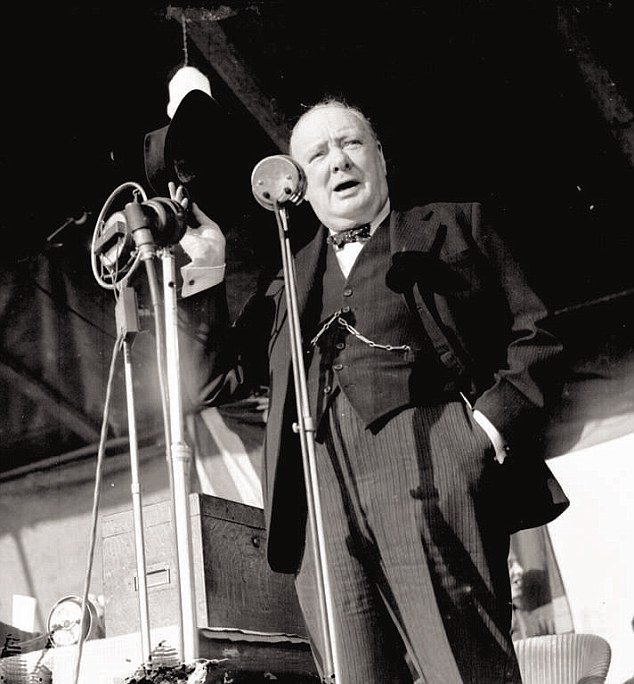
On his way home from a Mediterranean cruise in 1927, Churchill — then Chancellor of the Exchequer — dropped in on the casino at Dieppe and, playing baccarat, lost £350 — the equivalent of £17,500 today
That condition proved no problem: Churchill was determined to enlist the military might of the United States and American guests became frequent visitors to Chequers.
To pare back the tax demands, Churchill tried every possible ruse, even assigning some of his earnings as an author to his son Randolph, who was taxed at a lower rate.
This subterfuge could save £1,500 (£75,000) but it made Churchill uneasy — not least because Randolph’s gambling was even more reckless than his own.
What finally rescued Churchill’s finances, and put him on a stable footing for the rest of his life, was Hollywood.
In 1943, an Italian immigrant film producer paid him £50,000 (£2.5million) for the movie rights to his biography of his ancestor, the military genius Lord Marlborough.
The death of Sir Henry Strakosch in October 1943 brought a legacy of £20,000 (£1million) as well as cancelling a loan.
As D-Day approached, Churchill was solvent for the first time in 20 years. By the end of the war, he had collected another £50,000 (£2.5million) for the film rights to his History Of The English-Speaking Peoples.
And a further colossal bonus came when he was unexpectedly ousted from Downing Street by the voters in July 1945: on the day of his resignation, offers began to flood in from publishers around the world for his war memoirs.
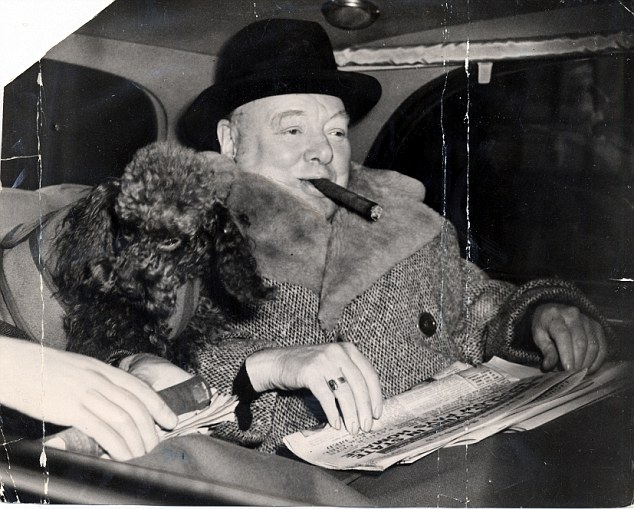
Winston holidayed in the South of France 12 times during the Thirties and always gambled at the casinos. He came home a winner only once
Traditionally, generals and admirals who won great victories were rewarded by Parliament. Earl Haig, the Army’s commander-in-chief during World War I, was awarded £100,000 (£500,000) in 1918.
There could be no such payment for an ex-Prime Minister. But a group of his admirers came up with a scheme to buy Chartwell for the National Trust, then rent it back to the Churchills for a nominal sum. Churchill was delighted.
Despite this unaccustomed security, he was not above seizing a chance to bypass the taxman.
As bidding for his memoirs topped $1 million (£12.5million) from an American consortium, Churchill was investigating another scheme: by gifting his entire personal papers, including future memoirs and diaries, to a trust in his children’s name, he figured he could avoid most tax on his writings.
He planned to pen his books for a smaller fee, under the pretext of ‘editing’ them.
This editing proved to be thirsty work. When Churchill decamped to Marrakech in Morocco to work on the manuscript in 1947, his entourage’s drinks bill for five weeks came to more than £2,100 (£73,500).
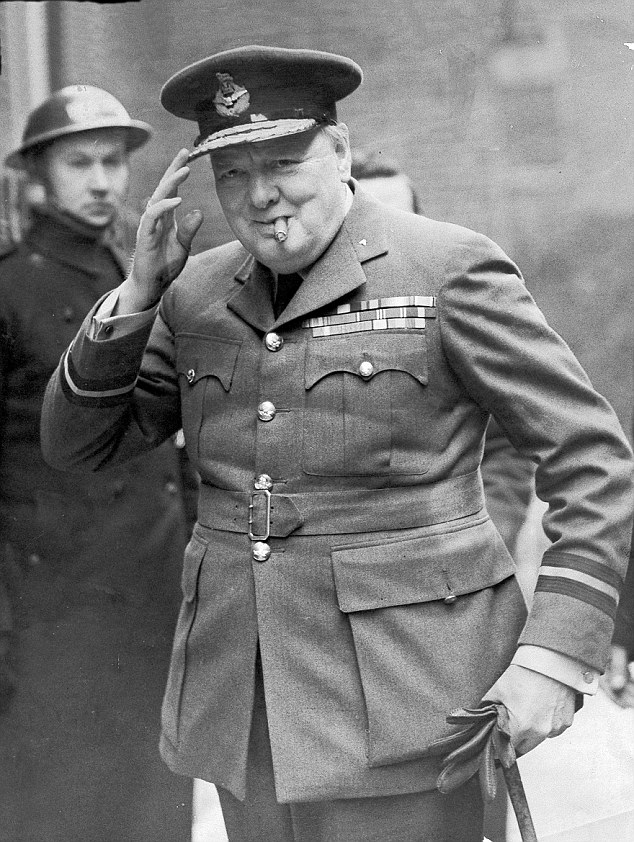
In a two-month spell in 1949, Churchill and his house guests at Chartwell drank 454 bottles of champagne, 311 bottles of wine, 69 bottles of port, 58 bottles of brandy, 58 bottles of sherry and 56 bottles of whisky
One of his secretaries wrote home: ‘The money here aren’t ’arf going!’
It continued to ‘go’ for the rest of his life. By the time he became PM again in 1951, his annual expenses were about £40,000 (£1 million), much of it on a staff of Swiss nurses and footmen, all of them vetted by MI5.
But now the honours flowed in. He won the Nobel Prize for Literature, a tax-free £12,000 (£300,000). He turned down a dukedom on the grounds that a dukedom without a great landed estate would be an embarrassment.
When he died aged 90 on January 24, 1965, the world mourned. But some had a particular reason to regret his passing: they would never see such a customer again.
In France, Madame Odette Pol-Roger instructed that a black band of mourning should be placed around the label of every bottle of her family’s champagne.
n Adapted by Christopher Stevens from No More Champagne: Churchill And His Money, by David Lough, published by Head of Zeus at £25. © 2015 David Lough. To buy a copy for £18.75 visit mailbookshop.co.uk or call 0808 272 0808. Offer until September 19, p&p is free.

Saturday, September 12, 2015

The state of Army Barracks not good enough for 'refugees' - but good enough for British Army !


Hameln, Germany - 28 Engineer Regiment move out - 'refugees' move in !

News just in that 28 Engineer Regiment have moved out of barracks at Hameln in Germany, and the first 90 'refugees' are moving in.


But get this !

They are now going to modernise the barracks for the 'refugees' !

Other Army Barracks also being put 'into service' for the 'refugees' apparently. Celle is also a place being used.

 -----------------------------------------------------------------------------------------------------------
 Be this afternoon between 16 and 18 a further 200 refugees in hameln on the barracks area is expected to be at the time on the way from Munich are here.

Chairman Tjark Bartels is overwhelmed by the spendenbereitschaft the district office, and aid agencies already has achieved and would like to thank all donors and donor for your sympathy and generosity.

As before, especially warm outerwear for men, women and children requires: Jackets, sweaters, pants and shoes.

For An effective adoption of clothes donations are the citizens by the levy ideally bundled clothes pieces.

For the coordination of donations is sophie münch from the district of Hamelin-Pyrmont Under 05151 / 903-3011 as a contact person available.
There is also the opportunity to work with the fiz (family in the centre) under 05151/202-3456 contact.

On the grounds of the linsingen barracks in hameln, süntelstraße 24, donations directly from the drc at the entrance area.

-----------------------------------------------------------------------------------------------------------


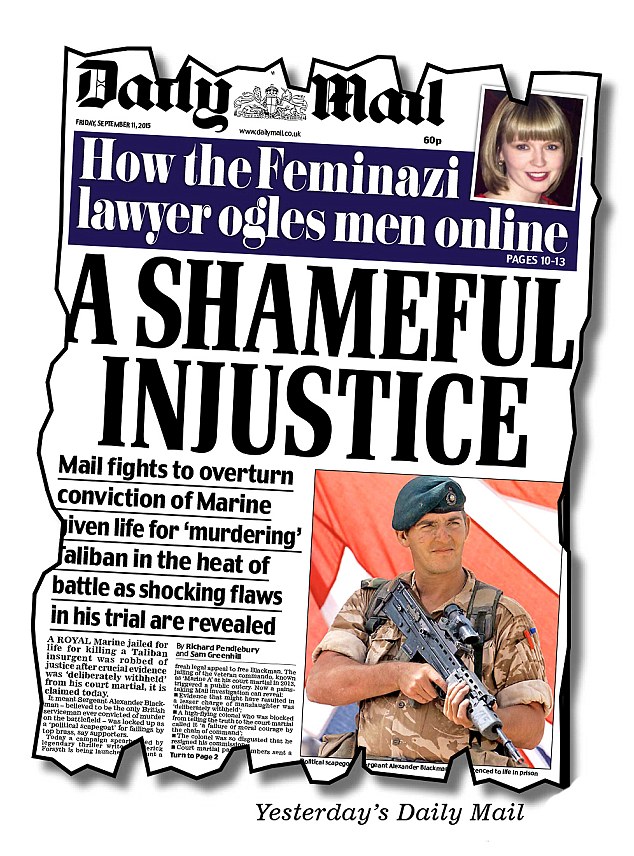
A shameful injustice: Now we reveal top brass plot to cover up vital evidence that could vindicate Marine given life for 'murdering' Taliban in the heat of battle 

  • Sergeant Alexander Blackman's was convicted of murder in 2013
  • He was accused of shooting dead a 'mortally wounded' Taliban terrorist
  • He is thought to be the only British soldier convicted of a battlefield murder
  • The military is planning to 'absolve' itself of all responsibility from the case 
  • His family and supporters have launched a fighting fund to support the costs of his appeal. To contribute, visit www.dailymail.co.uk/blackman

Sergeant Alex Blackman, pictured with his wife Claire on their wedding day in December 2009. Mrs Blackman said she is overwhelmed by the level of public support received by her husband 
Military chiefs are plotting to cover up a damning report that could help free a Royal Marine jailed for murder.
Evidence casting doubt on Sergeant Alexander Blackman’s conviction for killing a Taliban insurgent is to be ‘swept under the carpet’, the Mail can reveal.
His fight for justice was boosted by a huge wave of public support yesterday after we revealed that crucial facts were deliberately withheld from his court martial in 2013. The Mail has already reported that:
  • The Afghan fighter that Blackman shot had been mortally wounded;
  • Two of his comrades had been blown up, a third tortured and the limbs of mutilated soldiers hung from a tree by the Taliban;
  • His commanding officer resigned in disgust at his treatment.
And yesterday it also emerged that:
  • The jury trying Blackman was split 5-2 and put under pressure to convict;
  • Some were desk-job sailors without experience of battle;
  • The defence team blundered by failing to fight for a manslaughter conviction;
  • The Royal Navy is plotting a ‘media strategy’ to hush up findings of failures by senior commanders;
  • Retired military chiefs including Lord Dannatt called for the case to be re-examined.
Last night Blackman’s wife Claire said she was overwhelmed by the response from the public so far, and immensely proud of her husband, who had been made to ‘pay terribly for one mistake in the heat of battle’.
She added: ‘This was war. This man would gladly have tortured my husband before killing him if the roles had been reversed.’
Supporters say the veteran commando – believed to be the only British serviceman ever convicted of murder on the battlefield – was made a scapegoat for failings by top brass.
The Mail has discovered that an inquiry, commissioned after the murder conviction for wider lessons to be learnt from the incident, was given a disturbing insight into failings by Blackman’s superiors that directly contributed to his state of mind at the time of the shooting.
But instead of making these failings public, the Ministry of Defence is planning to absolve itself of all responsibility and heap further blame on Blackman, a secret letter seen by this newspaper suggests.
Claire Blackman said the Taliban terrorist would have 'gladly tortured my husband before killing him'
Last night Frederick Forsyth, the author spearheading the campaign for justice for Blackman, said: ‘It is disgraceful that navy top brass plan to sweep under the carpet evidence which could help Sgt Blackman.
‘He and his men were abandoned in an Afghan hell on earth until they were dangerously exhausted – a grenade with the pin out.
‘Now the sergeant has been left to rot in jail while the brass pretend they have never heard of him.’
The campaign aims to fund a new legal appeal to the Criminal Cases Review Commission, which has the power to send his case back to the Courts Martial Appeal Court where his murder conviction could be reduced to manslaughter.
Within hours of the campaign being launched yesterday, more than a thousand people had sent messages of support.
Many also donated money online to fund the Blackmans’ legal appeal, with one person even hand-delivering a £50 cheque to the Mail’s office in London.
Backers from all over the world vowed to help the jailed serviceman clear his name, including hundreds of veterans and professionals from all walks of life.
Author Frederick Forsyth, who is leading the campaign for Sgt Blackman's release said: 'He and his men were abandoned in an Afghan hell on earth... now the sergeant has been left to rot in jail' 
By September 15, 2011, when Blackman shot the insurgent his troop had already become ‘psychologically defeated’, according to an official assessment.
The Mail’s investigation has uncovered the truth behind the ‘tour that broke J-Company’. Alleged chain of command failings, unheeded warnings, under-manning and equipment shortages put unimaginable pressure on the Royal Marines manning the front line.

HOW YOU CAN HELP

Sergeant Blackman's family and supporters have launched a fighting fund to support the legal costs of his appeal.
If you would like to contribute, visit www.dailymail.co.uk/blackman for details of how to pay by cheque, PayPal or through online banking.
Donations will be received by a not-for-profit company, Justice For Sgt Blackman Ltd.
If there is any money left in the fund at the end of the appeal process then the money will be donated to good causes.
The isolated troops were forced to pursue Downing Street’s ‘hearts and minds’ strategy – while the Taliban were taunting them by displaying the body parts of their mutilated comrades in a tree.
Yesterday Lord Dannatt, former head of the British Army, rejected Blackman’s claim that his conviction for murder was part of a ‘hearts and minds’ campaign to win over Afghan opinion and ‘show the world how politically correct we are’.
But he said that ‘if there is new information it should be put on the table and the case should be opened up’.
Major General Julian Thompson, who led the Marines in the Falklands, said: ‘I have thought from the very beginning that the case should be reopened. I have always believed that the sentence was far too stiff.’
Tory MP Adam Holloway, a former Captain in the Grenadier Guards who fought in the First Gulf War, said: ‘I have known [the colonel who resigned] Ollie Lee well for 20 years and what he’s saying must be correct. The case should be reopened.’ 
How Mail launched fight to overturn Marine's conviction 
By SAM GREENHILL 
The campaign for justice for Alexander Blackman was launched yesterday with a Daily Mail investigation revealing how evidence was ‘deliberately withheld’ from his court martial.
Had the Royal Navy jury known the full facts, a lesser charge of manslaughter might have saved the Royal Marine from being convicted of murder.
One of the most damning revelations was that a high-flying colonel resigned his commission in disgust at the treatment of the jailed serviceman.
The Daily Mail has launched a high profile campaign to overturn Sergeant Blackman's conviction 
Yesterday the Mail revealed Sgt Blackman's Commanding Officer Colonel Oliver Lee, pictured, resigned his commission and left his promising military career due to his disgust at the handling of the Marine's case
Colonel Oliver Lee wanted to give crucial evidence that would support Blackman, but was refused by his chain of command. The youngest Royal Marine to hold the rank of colonel since the Second World War, Colonel Lee accused the hierarchy of deliberately withholding details of crucial operational failings leading up to the shooting incident, according to documents seen by the Mail.
When he resigned, he told his superiors: ‘Sgt Blackman’s investigation, court martial and sentencing authority remain unaware to this day of the wider context within which he was being commanded when he acted as he did. My attempts to bring proper transparency to this process were denied by the chain of command. Sgt Blackman was therefore sentenced by an authority blind to facts that offered serious mitigation.
‘The cause of this is a failure of moral courage by the chain of command.’
The Mail’s investigation has uncovered the full facts of the disastrous 2011 tour of Helmand province. It reveals alleged key operational failings by commanders that meant Blackman and his troop were scandalously isolated, under-manned, under-resourced and under daily Taliban assault – all directly affecting his state of mind at the time. This led to Blackman not receiving a fair trial, it is claimed.
Blackman was a highly experienced Marine destined for promotion when, on September 15, 2011, he led a patrol to check on a Taliban gunman who had been mortally wounded trying to storm a British outpost. It was near the end of a horror-filled tour of Afghanistan in which seven fellow Marines had been killed and 40 injured by the Taliban.
The insurgent was found dying in a field, and was shot by Blackman, who told the court he believed that the man was already dead. He blamed the ‘moment of madness’ on the acute stresses of the battlefield.
In an online petition, more than 100,000 people demanded leniency for Blackman, who had served five tours of Iraq and Afghanistan with courage and distinction. A fighting fund has been established and supporters are invited to make a contribution towards his legal costs.
Truth censored by the top brass: Evidence that backs jailed Marine Alexander Blackman to be cynically suppressed
By SAM GREENHILL
Covered in the censor’s black ink, this is the official report the Navy plans to publish into the shooting incident – with only Blackman’s name visible.
The report draws ‘challenging’ conclusions about failures through the chain of command.
But instead of making these public, it plans to conveniently absolve military chiefs of responsibility while piling all the blame on the jailed Royal Marine.
The Navy will release a redacted report covering up the failures of senior brass involved in the Blackman case
The Navy only wants the public to see a single page of a 50-page report into Sgt Blackman's case
The single page is all the Navy wants the public to know about its inquiry into the case, the investigation by the Daily Mail has discovered.
Military top brass have been plotting the cover-up for weeks – vowing to use a loophole in the Freedom of Information Act to deny the public the full truth.
The lengthy internal inquiry – codenamed Operation Telemeter – was commissioned by Navy chiefs after Blackman was convicted. Its purpose was to investigate what went wrong on the battlefield and ensure lessons were learned. The resulting report is 50 pages long – and will not be made public.
However the Mail has obtained a damning internal letter making clear the inquiry found failings in the chain of command. It also reveals a ‘media handling strategy’ to release only a single page, in heavily redacted form.
Written to military chiefs in July by the Fleet Commander of the Royal Navy, Vice Admiral Sir Philip Jones KCB, and seen by the Mail, the letter states: ‘The full review will remain a controlled document. Unsurprisingly, however, knowledge of the review is in the public domain and there have been requests under the Freedom of Information Act for it to be published.
The Navy only wants the public to see a single page of a 50-page report into Sgt Blackman's case
The report claims that the investigation 'may make uncomfortable reading for some' with
‘That is NOT the intention but we will be releasing a redacted version of the executive summary by the end of September.’
He added that the report’s findings ‘may make uncomfortable reading for some’. Sir Philip states: ‘In Blackman’s chain of command... it has identified what might have been done differently.’
He demanded the report’s ‘challenging findings and recommendations are adhered to’, and said several individuals were affected – none named publicly.
This is at odds with the official line that only Blackman was to blame for the incident.
After he was jailed, Prime Minister David Cameron described Blackman’s case as ‘an appalling story’ and said it would not ‘besmirch the incredible work of the Royal Marines’.
However his supporters say the Operation Telemeter report – even in redacted form – makes it clear that others in the chain of command come in for criticism.
Sergeant Blackman's family and supporters have launched a fighting fund to support the legal costs of his appeal.
If you would like to contribute, visit www.dailymail.co.uk/blackman for details of how to pay by cheque, PayPal or through online banking.
Donations will be received by a not-for-profit company, Justice For Sgt Blackman Ltd.
If there is any money left in the fund at the end of the appeal process then the money will be donated to good causes.
The Freedom of Information Act contains provision for the military to refuse requests by citing national security.
The report 'may make uncomfortable reading for some' within Sgt Blackman's chain of command
The single page the Navy has decided to publish by the end of this month is covered in black ink. After four paragraphs of obscured findings, the review has just one answer to what went wrong – Blackman.
The conclusion for public consumption is: ‘Sgt Blackman allowed professional standards to slip to an unacceptably low level.’
Last night author Frederick Forsyth, leading the campaign for Blackman, said: ‘He was made the scapegoat at the court martial, and now he is to be made the scapegoat again.
‘It is disgraceful that Navy top brass plan to sweep under the carpet evidence which could help Blackman.
‘He and his men were abandoned in an Afghan hell on earth until they were dangerously exhausted – a grenade with the pin out. Now the sergeant has been left to rot in jail while the brass pretend they have never heard of him.’
Court martial panel 'was split 5-2 over guilty verdict'
By SAM GREENHILL  
Alexander Blackman was found guilty by only five of the seven jurors trying him, it was claimed yesterday.
The other two officers on the court martial panel are said to have come under ‘very considerable pressure’ to change their not guilty verdicts.
It meant the Royal Marine sergeant was convicted by a 5-2 majority, which would not be adequate in a civilian trial. If 12 jurors are split by a similar ratio at crown court there is a hung jury – leading either to a retrial or the charges being dropped.
Sgt Blackman was saluted by members of the jury panel after his conviction which is highly unusual 
But the different rules of a court martial meant just five guilty votes were enough to see Blackman convicted of murder and jailed for life.
After he was sentenced, members of the panel broke with the rules and saluted the condemned man, recalls Blackman’s wife Claire.
‘They saluted and let it be known afterwards it was because they thought Al was a decent man,’ she said.
Frederick Forsyth, who is spearheading the campaign for justice for Blackman, said: ‘Honourable men do not salute a perjurer and a murderer.
‘They were sending a message and what they were saying was “We’ve done what we were told to do”.
‘This court martial, in my view, stank from top to bottom.’
Sgt Blackman, pictured, needs to take case via the Criminal Cases Review Commission which is the statutory agency set up to rectify miscarriages of justice, to the Court Martial Appeal Court 
The best-selling thriller writer alleges there was behind-the-scenes meddling by top brass to fix the result of the case. He said: ‘Two to five was the verdict. I know this to be true, I cannot reveal how. This is shaky by any measure.
‘One of the seven who voted not guilty says he and another man were put under very considerable pressure to change their view, and to conform to the guilty verdict they believed was what was required.
‘The question is, who was applying this pressure and who was giving the orders for a guilty verdict?’
Any suggestion of pressure on a jury in a crown court would immediately cause the trial to be halted.
Last night Baron Burnett, a Liberal Democrat peer and former Royal Marine who has visited Blackman in prison, said: ‘If it were 5-2 in a civilian court, this would not be sufficient to convict somebody.
‘When did a court martial last try a serious murder case? They do not have much experience in these matters. The court martial system is flawed and needs to change. I have been told that a Royal Marine colonel was telephoned by a member of the panel after the hearing and told: “We were under terrific political pressure”.’
The path to justice for Blackman now leads via the Criminal Cases Review Commission to the Courts Martial Appeal Court. The CCRC is the statutory agency set up to put right miscarriages of justice.
It cannot overturn a conviction or sentence, but it does have the power to refer a case back to the appeal court if it believes there is a ‘real possibility’ it might be quashed there.
Spearheaded by leading defence QC Jonathan Goldberg, his new legal team will first submit a lengthy written report for the CCRC to consider.
They intend to offer fresh evidence of post-traumatic stress disorder due to combat fatigue,
Meanwhile, it has been claimed that the seven-strong jury deciding Blackman’s fate were mainly desk-based sailors. It is understood that only two of the Royal Navy and Royal Marine officers on the panel had much ‘on the ground’ experience of the savage fighting in Afghanistan.
Frederick Forsyth said they ‘cannot have begun to imagine the hell of Helmand’.
The judge, advocate general Jeff Blackett, worked in the supplies branch of the Navy and then pay and pensions, before going into the legal section of the services.
The president of the panel of jurors was Lt Col Christopher Holmes of Navy command headquarters. Other members were: Lt Cmdr Love, of the defence equipment and support centre; Lt Cmdr Nick Cory, of the joint signals unit; Lt Evans, of HMS Collingwood, an office building in Portsmouth; and Warrant Officer Gowers, of an assessment centre in Portsmouth.
More battlefield experience came with Major Adam Whitmarsh, of 43 Commando Royal Marines, who three years ago was commended by the Queen for hunting down Somali pirates.
His team helped free a Pakistani dhow and an Italian vessel. The 30 captured Somalis were sent for trial in Italy and the Seychelles.
Major Whitmarsh had also served in Northern Ireland and Iraq and completed two tours of Afghanistan.
The seventh panel member was Captain Ben Sercombe, a Royal Marine and commander of Britain’s amphibious forces for the past two years. He has served in Afghanistan, but has also found time to be a champion of the Royal Marines Angling Association.
Hell that drove hero to the brink: Day by bloody day came torture, murder and atrocities that would shred the strongest nerves. Read what Sgt Blackman endured and ask: Would you have SNAPPED?
A report into the Sgt Blackman case found there were alleged 'chain of command failings' strategic confusion and even criminal under-manning 
By RICHARD PENDLEBURY 
Commissioned by the Royal Navy’s Fleet Commander, Vice Admiral Sir Philip Jones, and conducted by a respected Royal Marine brigadier, the investigation into the court martial of Sergeant Alexander Blackman took almost a year longer than expected.
Dozens of service personnel were interviewed. But the time and effort were justifiable: the matters under scrutiny concerned one of the most high-profile, damaging and controversial cases in British military history.
There has been much anticipation of the report’s findings on what it described in its preamble as ‘the events ancillary to the murder of an unknown insurgent in the Nad-e Ali North district of Helmand Province, Afghanistan, on September 15, 2011, by Sgt Blackman, a member of J Company, 42 Commando’.
The report, given the codename ‘Telemeter’, runs to more than 50 pages. How, then, can the military authorities explain that the public — which bridled at Blackman’s murder conviction and ten-year jail sentence — is to be allowed to see only three and a half paragraphs?
As we reveal today, military chiefs have decided the rest should be suppressed entirely, or redacted with blocks of black ink.
It is a whitewash. A cover-up.
But an investigation by this newspaper has been able to draw upon leaked official documents, military and Whitehall sources, legal papers in the possession of Sgt Blackman’s family and the testimonies of some of the service personnel directly involved in the fighting.
And our own findings now allow us to tell the uncensored story of 42 (pronounced Four-Two) Commando’s Helmand tour in the summer of 2011.
It is a story of alleged ‘chain of command’ failings, unheeded warnings, strategic confusion, criminal under-manning, equipment shortages and brutal warfare that put unimaginable pressure on junior ranks on the ground.
It is a story that Sgt Blackman’s court martial was not allowed to hear; the story that the top brass still does not want to be revealed.
You may think it throws a different light on what Sgt Blackman described to me as a ‘split-second mistake’. It will no doubt be read with interest by the families of the seven dead and 40 wounded soldiers — many of them maimed for life — who served with 42 Commando that summer.
By the tour’s end, we have been told, a senior Army officer felt that J Company — numbering around 100 men — in particular was ‘psychologically defeated, bereft of ideas, unpredictable and dangerous’.
That could hardly be blamed on Sgt Blackman.
Indeed, many who read what follows — and learn more about the slaughter and chaos that unfolded on that tour in Afghanistan — will start to understand that it was enough to drive any man to the very brink. 
The Royal Marines were under immense pressure during their deployment to Afghanistan, file photograph
The Mail has learned that there had been official concerns about 42 Commando before Sgt Blackman joined in December 2010. We are told that assessors of the unit’s pre-deployment training were worried by the gung-ho approach of the marines.
Aggression is expected of an elite force, but the UK was moving towards a withdrawal from Afghanistan, which the Prime Minister, David Cameron, would announce in July 2011.
A more sophisticated, civilian-orientated strategy aimed at winning ‘hearts and minds’ was to take precedence over simply defeating the insurgents on the battlefield.
The marines of 45 Commando, who would be based in the Nad-e Ali (South) district, next to the one occupied by 42 Commando, had long been lectured on the importance of this. They had even attended workshops aimed at reducing the possibility of soldiers committing a ‘battlefield atrocity’.
Yet there remained a ‘desire’ among 42’s chain of command for a bloody toe-to-toe fight with the Taliban, the Mail has been told.
They had wanted and expected to be posted to Sangin, the most high-profile and deadly location in Helmand. They wanted to slug it out and win.
Instead, 42 Commando was posted to Nad-e Ali (North), which was apparently viewed by the unit’s pugnacious, rugby-mad Commanding Officer, Lt-Colonel Ewen Murchison, as a backwater. Lt-Col Murchison, who had commanded J Company on an earlier Afghan tour, asked Brigade HQ for his area of operation to be expanded. This was denied.
Not very long into the tour, the 42 Commando soldiers felt ‘marginalised, unsupported, under-resourced and peripheral’, the Mail has learned. They had encountered deadly improvised explosive devices, or IEDs, but few direct firefights with the enemy. 
One way that 42 Commando could take a more proactive role was to push out into Taliban-controlled areas.
So began the piecemeal deployments which would lead its marines to claim that they were being ‘stretched too far’.
The first major operation began on May 23, 2011. J Company was to lead a push into the ‘bad-lands’ to the east of their area of operation. They were to take on the Taliban known to be there, and establish a new base called ‘Toki’.
One Marine who served with Sgt Blackman said: 'My first impression of Al has not changed to this day, and it won't ever. He is a great leader of men and a good person. I don't remember him ever shouting' 
Some 55 marines from bases across Nad-e Ali (North) were to take part.
Sgt Blackman was to remain in charge of an outpost called Check Point Omar.
But several soldiers from his troop were co-opted to set up the new Toki base: his young commander Lieutenant Ollie Augustin, Marine Sam Alexander, who had won a Military Cross on a previous tour, Lance Corporal JJ Chalmers, a school teacher reservist and the son of a Church of Scotland minister, and a Canadian medic, Lance Corporal Cassidy Little.
Little is the son of a retired brigadier general in the Royal Canadian Air Force. He had come to England to pursue a career as a stand-up comedian but ended up a Royal Marine. At the start of the tour, he and Blackman had carried out the recce of their outpost.
He recalls: ‘My first impression of Al Blackman has not changed to this day, and it won’t ever.
‘He is a great leader of men and a good person. I do not remember him ever shouting because he not only had natural authority but a fantastic sense of humour.
‘He had empathy with his men and would give it to them straight.’
The marines tasked with establishing the Toki base were dropped by helicopter one day before dawn. They occupied the compound which was to be used as a new base.
By the time the sun had risen, they were engaged in full-blown battle. Soon they had taken five casualties, but the wounded could not be evacuated until the next day because of the intensity of the engagements. 
The marines at Toki received intelligence of a nearby Taliban stronghold. Three patrols pushed out on parallel courses.
During their Afghanistan deployment, the Taliban would taunt the Marines by hanging boob-trapped body parts from their comrades from a tree, still wearing their British military kit 
One was led by J Company’s boss, Major Steve McCulley, another by Lt Augustin and the third by Sergeant Rob Driscoll.
Cassidy Little was with Lt Augustin’s patrol. ‘We had just finished having lunch at the edge of a garden,’ he recalls of the final moments of his old life. ‘It was the greenest thing I had ever seen in Afghanistan.
‘A local was leading us through a supposedly safe route when he suddenly bolted.
‘We knew it was not good. We got the [mine detectors] out, but they didn’t pick up the bomb which was hidden in an archway.’
The resulting explosion was catastrophic. Ollie Augustin and Sam Alexander were both killed outright. JJ Chalmers, the school teacher, suffered life-changing injuries to his face and hands.
Cassidy Little’s right leg was torn off, while their Afghan interpreter later died of his wounds.
Rob Driscoll’s patrol heard the explosion a few hundred metres away and saw the tell-tale column of smoke.
The son of Scotland Yard’s celebrated Detective Chief Inspector Clive Driscoll, who secured the conviction of two of Stephen Lawrence’s racist killers, Driscoll had, several years before, taken part in the invasion of Iraq.
He recalls: ‘I had to urge my men to run across ground which we now assumed to be an IED killing field. We did not want to go — but we had to. Over the radio, the insurgents were being told “Finish them off”.
‘I remember the two members of [Augustin’s] patrol still standing were pulling the casualties out of the compound.
‘Everyone was covered in dust and blood. The injuries were horrific.’
Helicopters arrived to remove the casualties and leave behind an investigation team.
On one occasion helicopters failed to collect the body parts of wounded soldiers which were later displayed
But in the confusion and continued fighting, the aircraft departed without the casualties’ weapons and body armour. They also left behind their comrades’ body parts that had been blown off by the blast.
Driscoll says: ‘There were a lot of body parts which were put in bags. It was very hot and we still had to get back to the Toki base.
‘I made the decision not to order the lads to have to carry the body parts back. But we could not leave them there. So I burned them where we were. I burned Cassidy Little’s foot. I later told him I had done so.’ He gives a wan smile.
Worse was to come later that day; one of the tour’s defining horrors. ‘We got to within 200 metres of Toki when we saw human legs hanging in a tree, along with some British military kit,’ says Driscoll. ‘In the field next to the tree was a farmer and a boy.
‘It seemed obvious that the items in the tree were booby-trapped “trophies” placed there by the Taliban to taunt us. But as usual, the farmer insisted there were no Taliban in the area.
‘As I spoke to him, a grenade came over a wall near us and landed behind me. Then a second one. The farmer and his boy were both injured. The fact that I was carrying extra body armour saved me from injury.’
Rob Driscoll believes the body parts in the tree belonged to a teenage marine from ‘L’ Company who had stepped on an IED earlier that month.
‘I never again want to see guys in the state they were in that evening,’ says Driscoll. ‘My guys completely lost it. One or two of the more mature men were operating at 30 pc. The rest had gone. They assumed the parts in the tree came from the guys from their company who had just been killed. They had had enough, though it was pure degradation, rather than shock.’
The next day, the marines returned to the location of the previous day’s incident, but the insurgents, says Rob Driscoll, ‘were one step ahead of us’. Another powerful expIosive device grievously wounded Major McCulley, as well as J Company’s Forward Air Controller.
‘There was a real feeling of “What’s the f*****g point? We are getting smashed and not achieving anything.” We had not spoken to locals or done anything measureable.
‘We had been sent in to stir up a hornet’s nest, but with no contingency plan after that.’ 
In the early hours of the morning of July 4, 2011, while Mr Cameron was visiting the Afghan capital Kabul, a 20-year-old Highlander named Scott McLaren, from Edinburgh, went missing having left his patrol base. Every available soldier in Helmand was sent out to find him, with Sgt Blackman among them.
‘I was told to get everyone I had available to a particular grid reference,’ he told me, ‘set up a check point and search all the vehicles which passed.
Sgt Blackman, right, was among a group sent to find a missing Scottish solider who had been captured, tortured and shot dead by the Taliban, but this event was not raised at his court martial 
‘At first, I wasn’t even told the reason, just “Go, go, go!” Only after we were out was I advised, “Friendly forces missing on ground.” ’
McLaren’s body was eventually found by another unit. He had been captured by the Taliban, vilely tortured and shot dead.
The sickening detail of what had happened to him became widely known among the marines.
Why didn’t Sgt Blackman mention this significant incident at his court martial, as proof of the intolerable strain that he and his fellow troops were put under?
‘If I had done so, I would have been questioned about it in detail,’ he told me. ‘And I didn’t know how much his family knew about what had been done to him. I did not want them to have to find out by reading the next day’s newspapers.’ 
By mid-summer of 2011, tensions between 42 Commando’s marines and the local Afghans were rising. The Afghan National Army commander in the vicinity threatened to stop his men working with the troops of 42 Commano because he believed they were ‘mistreating’ civilians, military sources say.
There was alleged tension between him and the British soldiers’ commander, Lt-Col Ewen Murchison.
A marine who did not wish to be named told me: ‘After the outrages at the Toki base, there was a definite shift in how the lads viewed the situation. ‘It was “These f*****s don’t want us to help them”.
‘We had local children brought to the base injured, but because the medic with us was a woman, the child’s father would take them away untreated.
‘One child given food by our patrol was killed by the insurgents as an example. Yet it didn’t really matter to the locals because the child was a girl.
‘The amount of cash I was handing out each week to people as compensation for a cow that had been killed in the fighting, or a tree or a wall that had been destroyed, was insane. But when we tried to establish some kind of relationship with the locals, they just weren’t interested.
‘It was very demoralising to sit down with people you knew would quite likely later be shooting at you.’
Eventually, the British commander in Helmand, Brigadier Ed Davis, was told of the tensions on the front line, along with concerns that 42 Commando were using too much ammunition.
Brigadier Davis decided 42 was generally doing OK, but the soldiers themselves did not agree. By high summer, many of the isolated British bases, including Omar, were woefully undermanned.
Sgt Rob Driscoll says: ‘I had to plead with my guys to go out. They knew they should be patrolling, because if they didn’t then the insurgents would be able to move the hidden belt of IEDs closer to our bases. The situation was madness. The insurgents were shooting at the base, they were dropping grenades in, and once they even tried to tunnel in.
‘We would come in from a patrol, get changed into new clothes and immediately leave to start a new patrol, to give the watching insurgents the impression that we had more people than we actually did.
‘Sometimes I feared we would be overrun in the night.’
He adds: ‘The majority of my commanders I have absolute admiration for. But big mistakes were made. We did not have direction or a sense of “this is what we want to achieve”.’
Sgt Blackman confirmed this view from prison: ‘The strategy was wrong. You could not build bridges if you were lying in a drainage ditch taking incoming fire — which is generally what happened when we left the base and tried to follow the mission brief.’
Three weeks before the tour was due to end — and only eight days before Alexander Blackman committed that supposed ‘murder’ — Nad-e Ali (North) and (South) were amalgamated into one command as part of the UK’s gradual withdrawal of troops.
Lt-Col Oliver Lee, the commanding officer of 45 Commando, was put in charge of all the marines in the unified zone. Lt-Col Murchison of 42 Commando was relocated to the central headquarters at Camp Bastion.
Sources say the fallout was acrimonious, and legal papers suggest that Lee believed J Company was in ‘disarray’. He even considered replacing some of its commanders, but headquarters said no. 
Rob Driscoll was medically discharged from the marines with permanent hearing loss caused by grenade explosions.
He says the 2011 tour also ‘broke’ him mentally. ‘My wife said that for the first year afterwards, it was like being married to a ghost.’ Today, he feels that Sgt Blackman’s life sentence is a ‘travesty’.
‘A s***load of marines have left the Corps because of what happened to Al. You cannot trust the system.
‘People sitting at home have little understanding what they were asking our soldiers to do.
‘If the situation was reversed, and Al had been captured without a weapon, and that Taliban had been armed and unwounded, he would have called his mates and they would have crucified Al.’
Driscoll admits he had reached his own tipping point.
‘We were due to hand over to another British unit at the end of the tour, and I went on a familiarisation patrol with the incoming soldiers.
‘We got engaged by the enemy and we were trapped in a gully.
‘I felt such anger that I stood up from the ditch we were in and shouted at the insurgents to come out and fight us toe to toe.
‘The other guys were shouting at me to get down. But I had lost it. I had reached a turning point.
‘And that was a similar [psychological moment] to when Al did what he did.
‘Why can’t we forgive Al for making a mistake under incomparable pressure?
‘Most of us would have shot the Taliban in the circumstances. Does that make us all murderers?’
As for their colleague Lance Corporal Cassidy Little, he was watched by ten million TV viewers earlier this year as he won Comic Relief’s The People’s Strictly on his prosthetic leg.
Today, he says: ‘For a long time I avoided the subject of Al Blackman because I was still serving, and found it inappropriate to speak out.
‘But I want to say now that I would follow Al Blackman through the gates of hell.’
These brave men lost faith in many things during their time under fire in Helmand. But they never lost faith in each other.

WHY THE BATTLE FOR JUSTICE FOR SGT BLACKMAN IS SO IMPORTANT 

Sergeant Alexander Blackman – believed to be the only British serviceman ever convicted of murder on the battlefield – was locked up as a ‘political scapegoat’ for failings by top brass, say supporters.
Blackman was a highly experienced Marine destined for promotion when, on September 15, 2011, he led a patrol to check on a Taliban gunman who had been mortally wounded while attacking a British outpost in Helmand Province. It was near the end of a horror-filled tour of Afghanistan in which seven fellow Marines had been killed and 40 more injured by the Taliban.
The insurgent was found dying in a field, and was shot by Blackman – who told the court he believed the man was already dead – in a ‘moment of madness’ blamed on the acute stresses of the tour.
In his first interview, given in prison, Blackman, 41, told the Mail: ‘I made a split-second mistake, but I had been sent to a brutal battlefield to fight a war for my country. At the end of my trial, the Establishment lined up to portray me as evil, because it suited them … to show the world how politically correct we are. I have been made a scapegoat for all that went wrong there.’
Now a campaign spearheaded by legendary thriller writer Frederick Forsyth is mounting a fresh legal appeal to free Blackman - known as ‘Marine A’ after a painstaking Mail investigation revealed that evidence that might have resulted in a lesser charge of manslaughter was ‘deliberately withheld’.
A high-flying colonel who was blocked from telling the truth to the court martial called it ‘a failure of moral courage by the chain of command’. The colonel was so disgusted that he resigned his commission.
Also court martial panel members sent a message to Blackman – who is eligible for parole after eight years – apologising for the length of his sentence.
Sergeant Blackman's family and supporters have launched a fighting fund to support the legal costs of his appeal. 
If you would like to contribute, visit www.dailymail.co.uk/blackman 

Friday, September 11, 2015

Kuwait & Israel Admit They Refuse to Take ‘Refugees’ Because Migrants Don’t Assimilate

Media labeled Hungarian Prime Minister 'xenophobic' when he expressed similar concerns
Kuwait & Israel Admit They Refuse to Take 'Refugees' Because Migrants Don't Assimilate


While Europe is preparing to take in potentially millions of migrants from African and Middle Eastern countries, politicians in Israel and Kuwait admit that their policy of refusing refugees is because the migrants fail to assimilate and pose a huge threat to social cohesion and democracy.
Appearing on Middle Eastern television, a Kuwaiti politician stated, “In the end you cannot accept people from a different ethnicity, culture and environment.”
Striking a similar tone, an Israeli politician asserted, “We’ll bring in a million Africans, half a million Filipinos, 2 or 3 million Chinese, and that’s the end of it for Israel.”
Asked why it posed a threat to allow a million Africans into Israel, the politician responded, “It’s threatening because this will no longer be a Jewish state….our country is a Jewish state, a Jewish and democratic state.”
Israeli Prime Minister Benjamin Netanyahu also asserted that Israel does not have the demographic depths to absorb fleeing migrants.
However, prominent European voices like Hungary’s Prime Minister Viktor Orban, have been denounced as xenophobes by other politicians and the mass media for expressing similar concerns.
“We shouldn’t forget that the people who are coming here grew up in a different religion and represent a completely different culture. Most are not Christian, but Muslim…. That is an important question, because Europe and European culture have Christian roots,” wrote Orban.
The New York Times responded by characterizing Orban’s statement as a “xenophobic response”.
It’s interesting that countries like Kuwait and Israel can assert (and rightly so) that opening the floodgates to vast numbers of unassimilated immigrants is tantamount to national suicide, but when European leaders make the same argument, they are castigated as xenophobes and racists.
http://www.infowars.com/kuwait-israel-admit-they-refuse-to-take-refugees-because-migrants-dont-assimilate/

Wednesday, September 09, 2015


 Poland bans anti-immigrant rally

Authorities in the Polish capital, Warsaw, have banned a protest against Muslim refugees that was planned for the city center on Saturday, saying it is driven by out-of-place hatred.
The decision follows a government announcement that Poland will be able to accept more refugees that the 2,000 originally declared and a declaration from Catholic leaders that the church will do its best to help immigrants.
Predominantly Catholic Poland appears to be gradually opening to the need of helping the plight of Muslims fleeing for their lives. But fears also remain.
Warsaw Deputy Mayor Jaroslaw Jozwiak said Wednesday that the organizers of the protest had used the "language of hatred" to justify it.

http://hosted.ap.org/dynamic/stories/E/EU_EUROPE_MIGRANTS_THE_LATEST?SITE=AP&SECTION=HOME&TEMPLATE=DEFAULT&CTIME=2015-09-09-08-50-45 

  Who knows what this famous banner is, and can you name it ?